
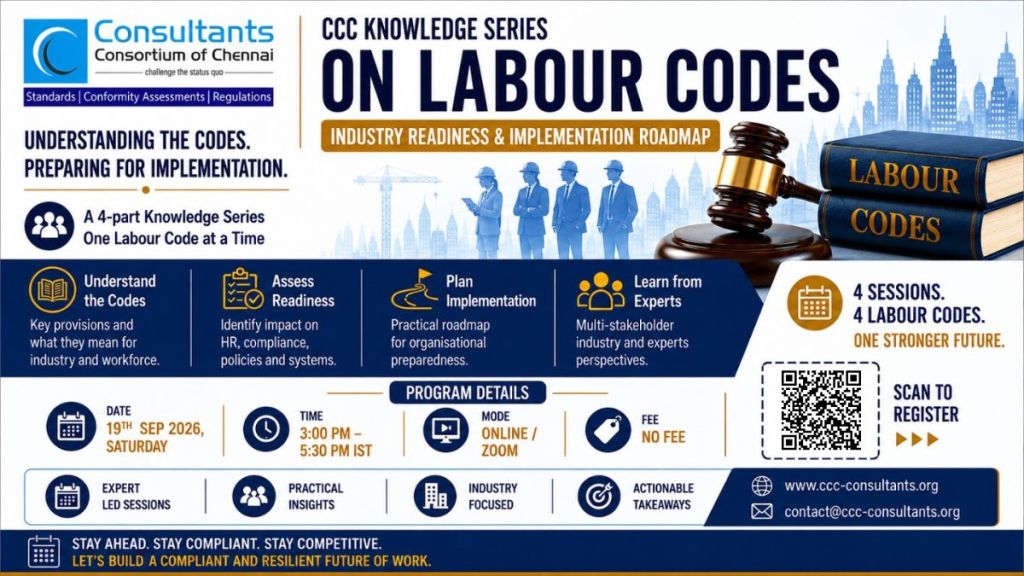
CCC Knowledge Series on Labour Codes : Industry Readiness & Implementation Roadmap
– Understanding the Codes. Preparing for Implementation.

About the Knowledge Series
The Consultants Consortium of Chennai (CCC) proposes a dedicated Knowledge Series on Labour Codes to help organisations, professionals and other stakeholders understand India’s evolving labour and employment regulatory framework and prepare for its practical implications.
The four-part series will examine the four Labour Codes, one Code at a time, enabling participants to progressively understand the framework, assess organisational readiness and identify areas requiring attention across HR, payroll, compliance, employment practices, workforce management and operations.
The series is designed not merely to answer “What does the Code say?”, but to address the more practical question: “What does industry need to do?”
The programme concept is based on CCC’s proposed approach of combining Industry Readiness with an Implementation Roadmap, including organisational preparedness, HR and compliance processes, documentation, systems and practical implementation challenges.
Why a Knowledge Series on Labour Codes?
India’s labour law framework has undergone a major legislative restructuring through four Labour Codes that consolidate and rationalise provisions from 29 Central labour laws.
The four Codes are:
- The Code on Wages, 2019
- The Industrial Relations Code, 2020
- The Code on Social Security, 2020
- The Occupational Safety, Health and Working Conditions Code, 2020
The Government of India has stated that the four Codes came into force with effect from 21 November 2025. They seek to simplify the labour law framework, reduce multiplicity of definitions and authorities, facilitate technology-enabled compliance and strengthen worker protections.
For industry, the significance goes beyond statutory compliance. The Codes can have implications for:
- Wage structures and payroll
- Employment terms and appointment documentation
- Industrial relations and workforce practices
- Social security coverage
- Contract and migrant workforce management
- Occupational health and workplace safety
- HR policies and documentation
- Contractor management
- Registers, returns and compliance systems
- Workforce planning and employment models
- Management of emerging workforce categories
The Ministry of Labour & Employment continues to provide the Codes, Rules, notifications, FAQs and related material through its official Labour Codes portal.
The Four Labour Codes – What They Mean for Industry
1. Code on Wages, 2019
The Code brings together provisions relating to wages, minimum wages, payment of wages, bonus and related matters.
Industry relevance: Organisations need to understand the impact on wage structures, remuneration components, payroll processes, minimum wage compliance, statutory calculations and employment practices. The Code provides for wider coverage of minimum wage provisions and a statutory floor wage framework.
2. Industrial Relations Code, 2020
The Industrial Relations Code consolidates provisions relating to trade unions, conditions of employment, industrial disputes and related industrial relations matters.
Industry relevance: The Code has implications for employer–employee relations, workforce policies, dispute management, standing orders, retrenchment-related processes, negotiating mechanisms and broader industrial relations practices.
3. Code on Social Security, 2020
The Social Security Code brings together provisions concerning social security and related benefits.
Industry relevance: Organisations will need to assess implications for EPF, ESI, gratuity, social security coverage and emerging workforce categories. The Code also recognises categories such as gig workers and platform workers, reflecting changing employment models.
4. Occupational Safety, Health and Working Conditions Code, 2020
The OSH & WC Code consolidates provisions relating to occupational safety, health, welfare and working conditions.Industry relevance: It has particular significance for factories, industrial establishments, construction, contractor workforce and organisations where occupational health and workplace safety are critical. Organisations will need to examine workplace safety systems, welfare provisions, working conditions, health requirements and related compliance responsibilities.
Programme Information
| Particular | Details |
| Programme | CCC Knowledge Series on Labour Codes Industry Readiness & Implementation Roadmap |
| Session Topic (1 of 4 Part Series) | Session on Code on Wages |
| Date | 19 September 2026, Saturday |
| Time | 3:00 PM – 5:30 PM IST |
| Mode | Online / Virtual |
| Participation Fee | No Fee |
| Registration | Click Here to Register |
| Organiser | Consultants Consortium of Chennai (CCC) |
Note: The four sessions will be conducted progressively over four months, with each session focusing on one Labour Code at a time
Target Sectors
The series is designed for organisations across both Manufacturing and Services, recognising that the practical impact of the Codes can vary according to workforce structures, employment models and operational environments.
Manufacturing Sector
- Manufacturing companies and factories
- Industrial establishments
- Engineering and automotive
- Electronics and electrical manufacturing
- Pharmaceuticals and biotechnology
- Healthcare and medical devices
- Chemicals and process industries
- Food processing and FMCG
- Textiles and apparel
- Construction and infrastructure
- Logistics and warehousing
- Contract manufacturing
- MSMEs and industrial enterprises
- Organisations employing contract and migrant workforce
Services Sector
- IT and ITES
- Professional and consulting services
- Financial and business services
- Healthcare and hospital services
- Education and training
- Retail and e-commerce
- Hospitality and tourism
- Logistics and transportation services
- Facility management
- BPO / KPO and shared services
- Start-ups and new-age businesses
- Knowledge-based enterprises
- Organisations with diverse and evolving workforce models
Who Should Attend?
The programme will be particularly relevant for:
- CXOs and Business Leaders
- HR Heads and HR Managers
- Industrial Relations Professionals
- Plant and Operations Heads
- Legal and Labour Law Professionals
- Compliance Heads and Compliance Officers
- Payroll and Compensation Professionals
- Finance and Accounts Professionals involved in payroll compliance
- Administration and Facility Management Teams
- EHS / Safety Professionals
- Employee Relations Professionals
- Contractor and Workforce Management Teams
- Factory and Establishment Managers
- Consultants and Management Systems Professionals
- Labour Law Practitioners
- Legal Advisors
- Trade Union / Employee Relations Representatives
- MSME Owners and Entrepreneurs
- Professionals responsible for organisational readiness and statutory compliance
Why Should You Attend?
Understand the Change
Get a structured understanding of the four Labour Codes and the areas of labour and employment regulation they address.
Translate Regulation into Action
Move beyond theoretical interpretation and understand what the Codes may mean for organisational policies, processes and systems.
Assess Organisational Readiness
Identify areas requiring review across HR, payroll, compliance, employment documentation and workforce practices.
Learn from Multiple Perspectives
Hear from legal, labour, HR, compliance and industry professionals rather than viewing the Codes from a single perspective.
Understand Manufacturing & Services Implications
Explore how common regulatory requirements can translate differently across factories, industrial establishments, IT/ITES, professional enterprises and other service organisations.
Prepare for Implementation
Develop a practical checklist of areas that management and functional teams should begin examining.
Participate in Industry DialogueEngage with peers and experts on practical challenges, interpretation issues and implementation expectations.
Expected Outcomes
Participants should be able to:
- Understand the structure and purpose of the four Labour Codes.
- Identify the principal provisions relevant to their organisation.
- Recognise areas of potential impact on HR and employment practices.
- Understand possible implications for wage and payroll structures.
- Identify social security and workforce coverage considerations.
- Recognise occupational health, safety and working-condition requirements relevant to their operations.
- Examine industrial relations and employee-management implications.
- Identify gaps in existing policies, documentation and compliance processes.
- Determine areas requiring coordination between HR, Legal, Finance, Operations, EHS and Management.
- Develop an initial organisational readiness agenda for the Labour Codes.
- Identify questions and issues requiring professional or legal interpretation.
Speakers & Expert Panel
Each session will bring together a carefully curated group of experts representing different dimensions of Labour Code implementation.
Chair
Shri Kumar Rajamani
Founder, 3i Quality Consultants
& GC Member, CCC
Co-Chair
Shri Sapan Kumar Bardhan
Sr Consultant on TQM, Best-Selling Author, and Motivational Leader
Industry Experts & Guest Speakers
Shri Yashvant Hande
HR Professional & Founder Director &
CEO – Innovative HR Services
Shri Ambarish Sharma
CHRO
Impresario Entertainment & Hospitality Pvt. Ltd
Shri Dnyanesh Chandekar
CMD & Editor in Chief – Chandekar Business Media Pvt.Ltd.
Chairman – Ulti-met Technologies Pvt.Ltd.
The proposed multi-stakeholder format is intended to bring together legal and labour experts, HR leaders, industry professionals, compliance practitioners, consultants and other stakeholders.
Programme Agenda

The Four-Session Knowledge Journey
The series will progressively cover the four Labour Codes:
| Session | Focus Area | Status |
| Session 1 | Code on Wages, 2019 | 19th Sep 2026, Saturday |
| Session 2 | Industrial Relations Code, 2020 | To be confirmed |
| Session 3 | Code on Social Security, 2020 | To be confirmed |
| Session 4 | Occupational Safety, Health & Working Conditions Code, 2020 | To be confirmed |
Each session will combine Code Understanding + Industry Implications + Organisational Readiness + Implementation Perspective.
A Common Platform for Manufacturing & Services
The Labour Codes create a common regulatory framework, but their practical implications can differ significantly depending on workforce structures, employment models, operational environments and business practices.
CCC therefore intends to bring Manufacturing and Services organisations onto a common knowledge platform to examine both:
What is common across sectors?
and
What is different in practical implementation?
This cross-sector approach is intended to help participants understand regulatory requirements while also appreciating the operational realities faced by different types of organisations.
About Consultants Consortium of Chennai
The Consultants Consortium of Chennai (CCC) is an association of Management Systems Consultants, registered under the Tamil Nadu Societies Registration Act, 1975.
CCC works as a platform for knowledge dissemination, professional development, regulatory awareness and industry engagement across Standards, Certifications, Regulations and Management Systems.
Through awareness programmes, professional training, knowledge sessions, industry collaborations and stakeholder consultations, CCC brings together industry, consultants, regulatory professionals, conformity assessment stakeholders and other ecosystem participants.
CCC’s established virtual learning and digital outreach capabilities enable it to connect with professionals and organisations across India.
Contact & Registration
WhatsApp :
Mrs Rama Venugopal – +91 9840870532
Mr S Giritharan – +91 98402 84489
Mrs Arthy Manivannan – +91 98415 94457
Emails :
contact@ccc-consultants.org
communication@cccassociation.org
CCC Knowledge Series on Labour Codes
One Code at a Time. One Session at a Time.
Building Industry Readiness Together.
Join CCC in creating a practical industry platform for understanding the Labour Codes and preparing organisations for the road ahead.